When Should Manual Gearbox Oil Be Changed?
When should manual gearbox oil be changed?
There is no mileage figure that applies to every manual gearbox. The correct service interval depends on the vehicle, gearbox design, specified lubricant and the maintenance plan issued by the manufacturer. Some schedules call for a fluid change at a stated mileage or age; others distinguish between inspection and replacement. Start with the owner’s handbook or an official service schedule for the exact model and transmission.
Why a universal kilometre interval can mislead
Two vehicles can use different gearbox designs and different oils even when their engines are similar. Their service instructions may therefore differ. A general internet recommendation such as “change it every X kilometres” cannot replace the vehicle-specific schedule. If the handbook is unavailable, a workshop can identify the transmission from the vehicle details and check the applicable specification rather than guessing.
Driving conditions also matter. Repeated heavy loads, frequent stop-start use, steep routes, sustained high speeds or operation at elevated temperatures can put more demand on drivetrain lubricants. These conditions are reasons to consult the manufacturer’s severe-use guidance and consider an inspection; they do not establish a universal shorter interval on their own. ZF likewise notes that transmission service intervals vary by manufacturer and that demanding operating profiles can affect oil ageing.
Why the correct oil specification matters
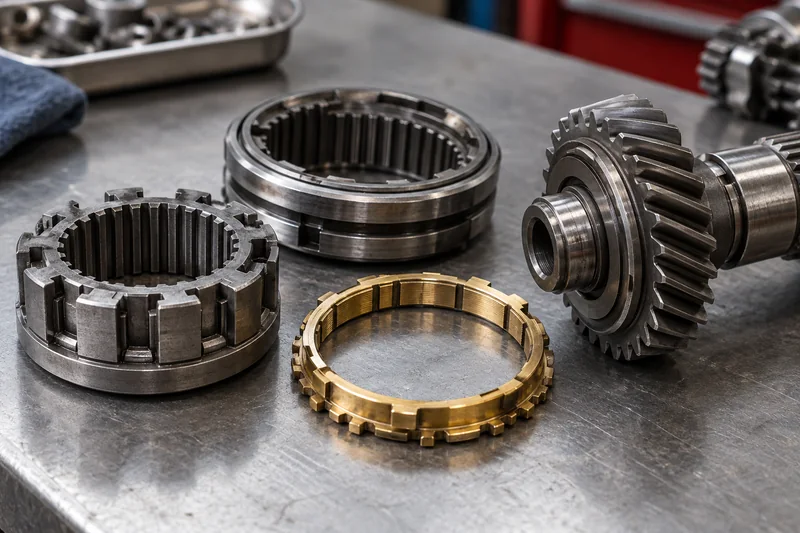
Gear oil lubricates gears, bearings and other internal surfaces. In a manual gearbox it also works with the synchronizers, which help match gear speeds during a shift. The required viscosity and performance specification are chosen for that particular unit. A fluid that merely seems similar—or an additive intended to make shifting feel smoother—may not meet the gearbox maker’s requirements.
Use only oil that meets the vehicle or gearbox manufacturer’s stated approval and specification. Do not select a product by viscosity alone, mix products without confirming compatibility, or add aftermarket additives unless the manufacturer explicitly permits them. Ford’s owner information, for example, instructs owners to use fluid meeting Ford specifications; the exact requirement is vehicle-specific.
Signs that deserve an inspection
Hard or noisy shifts, a new whine, a visible oil leak, or a change in shifting feel can justify checking the gearbox oil level and condition. These symptoms are not proof that the oil is the cause. A clutch that does not disengage fully, worn synchronizers, bearings, gear teeth, shift linkage or other faults can produce similar complaints. Diagnosis should consider when the symptom occurs, whether it affects one gear or several, and whether it changes with vehicle speed or temperature.
Oil appearance alone is not a reliable diagnosis. Darkened fluid, an unusual smell or particles may be reasons for closer examination, but interpretation depends on the gearbox and its service history. A leak should not be ignored: low oil can reduce lubrication, while simply topping up without finding the leak may leave the underlying problem unresolved.
What a proper check or change should include
The vehicle should be identified correctly and the manufacturer’s procedure followed. Depending on the design, the correct level may be checked at a specified plug with the vehicle positioned in a particular way. The amount, filling point, temperature conditions and tightening procedure can all be model-specific. A technician should use the correct oil and quantity, inspect for leakage, and note any abnormal debris or damage rather than treating every shifting complaint as an oil-change issue.
Working underneath a vehicle that is supported only by a jack is dangerous. If you see a leak or develop persistent grinding, difficulty selecting gears, or a sudden change in shift feel, arrange a professional inspection. Avoid forcing the lever or continuing to drive if gear engagement becomes unreliable.
Manual gearbox oil checks in Antalya
For drivers in Antalya, the useful question is not simply “how many kilometres?” but “what does the service plan for this exact gearbox require?” Frequent urban traffic, steep roads, long-distance driving and high operating temperatures can affect use, but the manufacturer’s instructions remain the reference. Keep service records and ask for the oil specification and work carried out to be recorded. That makes the next inspection more accurate and helps distinguish routine maintenance from a mechanical fault.
Frequently asked questions
Is manual gearbox oil changed at the same interval as engine oil?
No. The gearbox has its own service plan. Follow the interval and procedure specified for the vehicle and transmission.
Can I use any gear oil with the same viscosity?
No. Viscosity alone does not confirm compatibility. Check the exact manufacturer specification or approval.
Does difficult shifting always mean the oil needs changing?
No. Clutch release, synchronizers, linkage and internal wear can cause similar symptoms. Inspection is needed to identify the cause.
Should I change the oil if the vehicle has no scheduled interval?
Do not assume either that it must be changed at a generic mileage or that it never needs attention. Check the vehicle-specific service information and inspect the gearbox if there are leaks or symptoms.
Can I keep driving with a gearbox oil leak?
A leak can lower the oil level and risk inadequate lubrication. Have the source and level checked promptly, especially if noise or shifting problems appear.
Does Antalya’s climate automatically mean more frequent oil changes?
Not by itself. Driving pattern and actual operating conditions matter; use the manufacturer’s guidance for severe service and seek an inspection when needed.